Introduction
The Decoiler (or Uncoiler) is the foundation of every metal stamping line. It holds the coil, controls the tension, and ensures smooth pay-off into the straightener.
However, many factory owners struggle with a critical choice: Should you invest in a Heavy-Duty Hydraulic Decoiler, or is a standard Manual Uncoiler sufficient?
At Huagong Machinery, we believe the right choice depends on your material specifications. In this guide, we break down the differences, advantages, and limitations of both systems to help you choose the perfect coil handling solution.
1. The Manual Expansion Decoiler (Standard Duty)
Best for: Light coils, narrow strips, and budget-sensitive projects.
The manual decoiler is the traditional choice for precision electronics or small hardware stamping.
- How it Works: The operator manually rotates a hand crank or handle to expand the mandrel pads, gripping the inner diameter (ID) of the coil.
- Advantages:
- Cost-Effective: Significantly lower upfront investment.
- Simple Maintenance: No hydraulic fluids, pumps, or complex seals to maintain.
- Limitations:
- Physical Effort: Operators must use physical force to expand the mandrel.
- Weight Limit: Typically limited to coils under 2 Tons.
- Safety Risk: Not suitable for heavy or high-tension steel, as manual locking may not be secure enough for high-speed unwinding.
2. The Hydraulic Decoiler (Heavy Duty)
Best for: Automotive parts, appliance panels, and high-strength steel.
For modern automated lines, especially those processing coils over 3 tons, the Hydraulic Decoiler is the industry standard.
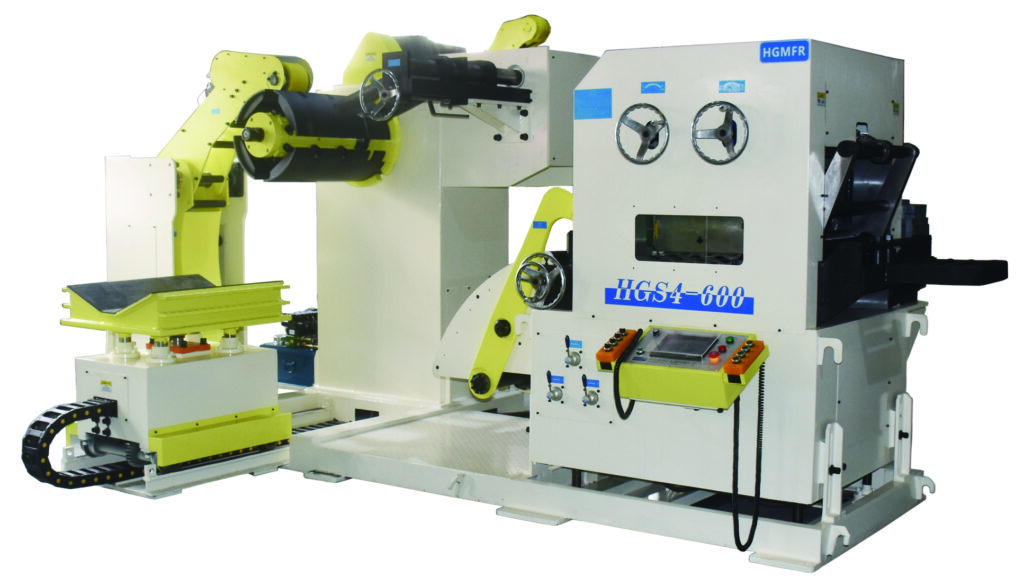
- How it Works: A hydraulic cylinder inside the mandrel automatically expands to grip the coil. It is often paired with a Pneumatic Pressing Arm to hold the coil down.
- Advantages:
- High Capacity: Can handle weights from 5 Tons up to 20 Tons.
- Automation: Expansion is done via button/touch screen, reducing changeover time from 20 minutes to 2 minutes.
- Stability: Constant hydraulic pressure ensures the coil never loosens during high-speed feeding.
- Safety: Essential for thick materials (>3mm) where “clock-springing” (the coil suddenly unraveling) is a danger.
- Huagong Feature: Our hydraulic models include a Variable Frequency Drive (VFD) for smooth acceleration, preventing sudden jerks that damage the material.
3. Comparison: When to Upgrade?
| Feature | Manual Uncoiler | Hydraulic Decoiler |
| Max Coil Weight | < 2,000 kg | 5,000 kg – 20,000 kg |
| Material Thickness | Thin (0.1 – 1.5mm) | Thick (0.5 – 12.0mm) |
| Expansion Method | Hand Crank (Slow) | Button / Hydraulic (Fast) |
| Safety Level | Standard | High (Pressing Arms + Inverter) |
| Price Point | Economy | Premium Investment |
Huagong Expert Advice:
If your coil width exceeds 500mm or the weight exceeds 2 Tons, we always recommend a Hydraulic system. The labor time saved on changing coils will pay for the machine difference within 6 months.
4. Essential Add-Ons for Hydraulic Decoilers
To maximize efficiency, Huagong recommends two optional upgrades for your hydraulic system:
- Hydraulic Loading Car (Coil Car):
- Lifts the heavy coil from the floor and slides it onto the mandrel automatically. This eliminates the need for a crane or forklift to align the coil perfectly, protecting the mandrel from impact damage.
- Pneumatic Pressing Arm:
- Applies downward pressure on the top of the coil. This is mandatory for high-tensile steel to prevent the outer layer from springing open and injuring the operator.
Conclusion
Choosing between a Manual and Hydraulic Decoiler isn’t just about price—it’s about safety and efficiency.
- Choose Manual for light, narrow, precision electronic parts.
- Choose Hydraulic for heavy, wide, or high-volume automotive and appliance stamping.
Still unsure?
Send your Coil Weight and Width specifications to Huagong Machinery, and our engineers will calculate the exact load capacity you need.