Introduction
The Mechanical Power Press is the heart of the metal stamping industry. From automotive body panels to tiny electronic terminals, these machines deliver the force needed to cut, punch, and form metal.
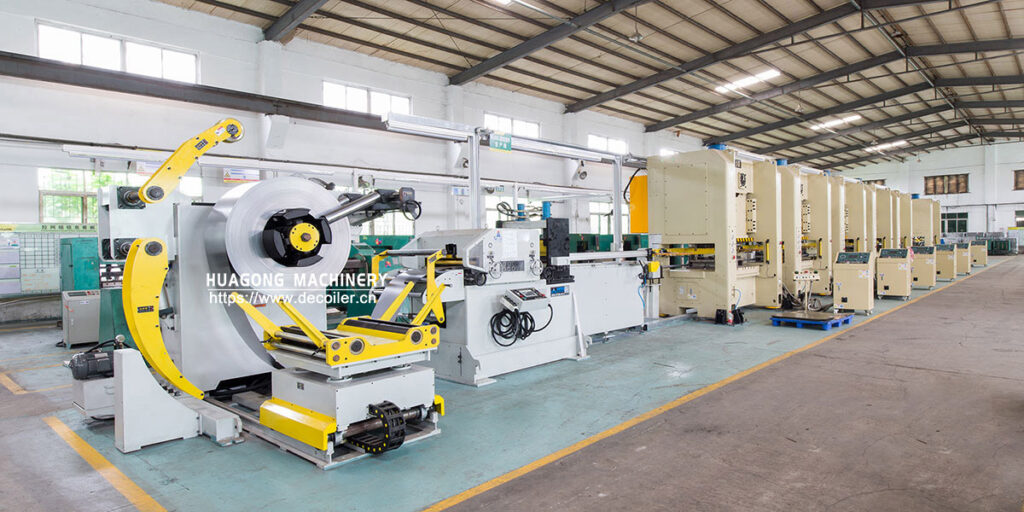
However, for a stamping line to run efficiently, understanding the press mechanism is just as important as choosing the right NC Servo Feeder. In this guide, Huagong Machinery breaks down the working principles and classifications of mechanical presses to help you design a better production line.
1. Working Principle: How Does a Mechanical Press Work?
Unlike hydraulic presses that use fluid pressure, a mechanical press relies on kinetic energy.
The process follows a specific chain of energy transmission:
- The Motor & Flywheel: The main motor spins a heavy flywheel. This flywheel stores rotational energy (inertia), acting like a battery for kinetic force.
- The Clutch & Brake: When the operator (or the automated signal) triggers a cycle, the clutch engages, connecting the spinning flywheel to the driveshaft.
- The Crankshaft: This converts the rotational motion of the flywheel into the linear (up-and-down) motion of the ram.
- The Ram (Slide): The ram moves down, carrying the upper die to strike the material sitting on the bolster plate.
Huagong Tech Note: The speed of this cycle is measured in SPM (Strokes Per Minute). High-speed mechanical presses can exceed 200 SPM, requiring a High-Speed Gear Feeder or NC Servo Feeder to keep up.
2. Classification: C-Frame vs. H-Frame Presses
When setting up a factory, the biggest choice is the frame structure.
A. C-Frame Press (Gap Frame)
- Design: Shaped like the letter “C,” open on three sides.
- Best For: Blanking, piercing, and light bending of smaller parts.
- Advantages:
- Accessibility: The open front and sides make it easy to change dies and clear scrap.
- Cost: Generally cheaper and takes up less floor space.
- Disadvantages: “Yawing” or deflection. Under heavy load, the “C” shape can flex slightly, affecting precision.
B. H-Frame Press (Straight Side)
- Design: A box-like structure with four columns (pillars).
- Best For: Heavy-duty progressive stamping, automotive panels, and high-precision parts.
- Advantages:
- High Rigidity: The box structure prevents deflection, ensuring longer die life.
- Stability: Can handle off-center loads better than C-frames.
- Disadvantages: More expensive and harder to access the die area manually.
3. Why the “Drive Mechanism” Matters for Feeding
Not all mechanical presses move the same way. The type of drive affects how you must program your Huagong Feeder.
- Crank Press: The most common type. The motion is like a sine wave—slow at the top/bottom, fast in the middle.
- Feeding Strategy: The feeder has a wide window to push material (typically 270° to 90° of the crank angle).
- Knuckle Joint Press: Uses a linkage mechanism to “dwell” (pause) at the bottom of the stroke.
- Feeding Strategy: Ideal for coining or embossing where the metal needs time to flow.
- Eccentric Geared Press: Delivers high torque at slower speeds.
- Feeding Strategy: Used for drawing deep parts. Requires a heavy-duty 3-in-1 Feeder with high torque to pull thick steel.
4. Integration: Syncing the Press with the Feeder
A mechanical press cannot work alone. For automatic production, it must be synchronized with the coil line.
- Cam Signals: The press sends an electrical signal (Cam output) to the Huagong NC Feeder telling it exactly when to start feeding and when to stop.
- Pilot Release: Just before the press hits the “Bottom Dead Center” (BDC), the feeder must mechanically release the strip so the pilot pins can align it. If this timing is off, you will break the die.
Conclusion
Whether you choose a versatile C-Frame or a rigid H-Frame mechanical press, the efficiency of your line is determined by the “feeding system.” Even the best press is useless if the material isn’t delivered accurately.
Huagong Machinery specializes in integrating high-precision Decoiler Straightener Feeders with all major press brands (AIDA, Chin Fong, Goanwin, Seyi).
Planning a new Press Line? Contact us to discuss the perfect Feeder-to-Press ratio for your specific product.